
Nursery storage works when it obeys the room’s real workflow: everything for a diaper change within one arm’s reach of the changing pad, clothes organized by SIZE (not season, not cuteness), and a zone system — sleep, change, feed, play — so every item has one obvious home. Get those three principles in place and the same 100 square feet that felt impossible at month one runs like a well-staffed station through toddlerhood.
Also Read



This is the complete nursery organization guide: the zone system, the size-sorting method that survives how fast babies grow, the storage pieces worth buying versus skipping, and the two-hour weekend reset that rescues an overwhelmed room.
Key Takeaways
- Organize clothes by size with dividers, shop-style — babies outgrow sizes in weeks, and the “too big bin” you can’t see into is where gifted clothes go to expire unworn.
- The changing zone runs on the one-hand rule: diapers, wipes, cream, and a change of clothes reachable while the other hand never leaves the baby.
- Closed storage (drawers, lidded baskets) for the bulk; open storage only for the daily-use pretty things — visual calm is a parenting feature, not a style choice.
- Rotate outgrown sizes OUT monthly into labeled bins; a nursery clogs with history faster than any room in the house.
- Every basket gets a label — 2 a.m. you and every helper who ever babysits will navigate by them.
- Anchor every dresser and shelf to the wall; storage that holds a climbing toddler’s weight is the only kind allowed in this room.

The Zone System (The Whole Room in Four Jobs)
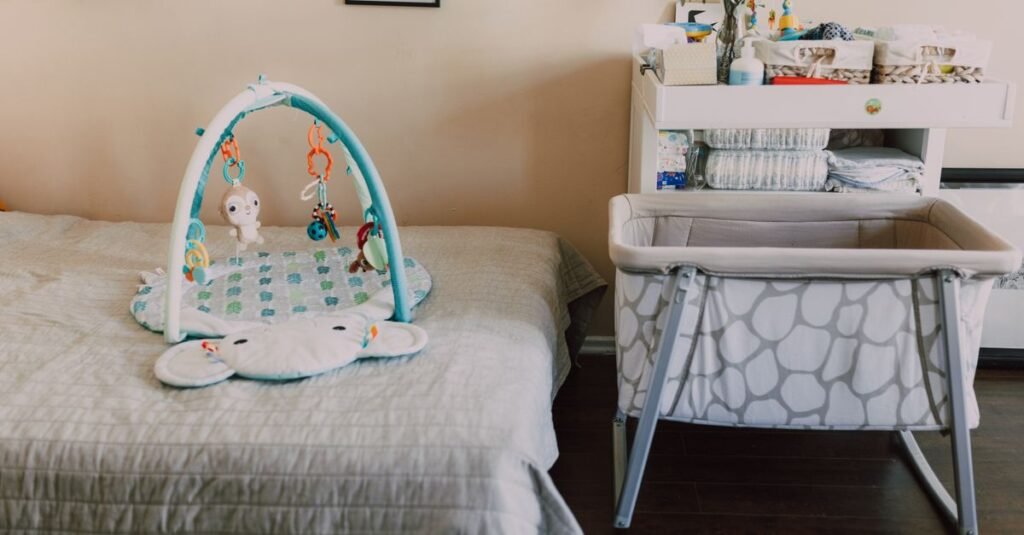
A nursery does four jobs, and organization means giving each job its own real estate: the SLEEP zone (crib, sound machine, and deliberately nothing else — clear space around the crib is both safe-sleep practice and visual calm), the CHANGING zone (pad, supplies, hamper, diaper pail in a tight working triangle), the FEEDING zone (chair, side table with one drawer or basket — burp cloths, water bottle for the parent, dim light within reach), and the PLAY/CLOTHES zone (dresser, closet, floor space that will grow into toy territory).
Zoning is what makes small nurseries work: when each corner has ONE job, nothing migrates, nothing piles, and anyone — partner, grandparent, sitter — can run the room without a tour. Our nursery setup guide covers the furniture placement half of this equation; this guide runs the storage half.
The Changing Zone (Where Organization Earns Its Keep Daily)
You will change roughly 2,500 diapers in year one — the workflow deserves engineering. The one-hand rule governs: one hand stays on the baby, so the other must reach everything. Top drawer or caddy: diapers standing on edge (grab-visible count), wipes, cream, hand sanitizer. Within the triangle: the hamper (lidded, one-hand lid) and the diaper pail on the pad’s other side.
The restock ritual: a “backstock” basket on the closet floor refills the working drawer every laundry day — running out mid-change is a rite of passage that only needs to happen once.
The caddy corollary: a portable second kit (diapers, wipes, cream, a mat) living wherever you spend daytime hours — because the nursery is upstairs and month-two you is not.

Clothes: The Size-Sorting Method (The Game-Changer)
Baby clothes fail normal organization because the inventory replaces itself every eight to twelve weeks. The method that survives: sort by size, ruthlessly, with visible dividers — exactly like a shop rack.
In the closet: hanging dividers marking newborn, 0–3, 3–6, 6–9, 9–12 months — gifted and hand-me-down clothes hang in their FUTURE size section the day they arrive, where they will actually be found in time.
In the dresser: current size only, file-folded standing up (visible at a glance, one-hand extractable — the fold pays for itself at 6 a.m.), with drawer dividers or small bins keeping bodysuits, sleepers, socks, and pants in lanes. Socks and tiny items live in a divided top-drawer insert — loose, they achieve quantum states.
The monthly rotation: outgrown sizes exit to a labeled bin (“0–3 OUT”) the moment the drawer gets tight — stored for a sibling, gifted onward, or donated. The single biggest cause of nursery chaos is three sizes cohabiting one drawer; the rotation ritual is the cure, and it takes ten minutes with a podcast.
Ashlynne Eaton’s nursery organization hacks above demonstrate the file-fold, dividers, and zone thinking on camera — the ideal visual companion.
The Storage Pieces: Buy, Convert, Skip
Buy (Earns Its Space for Years)
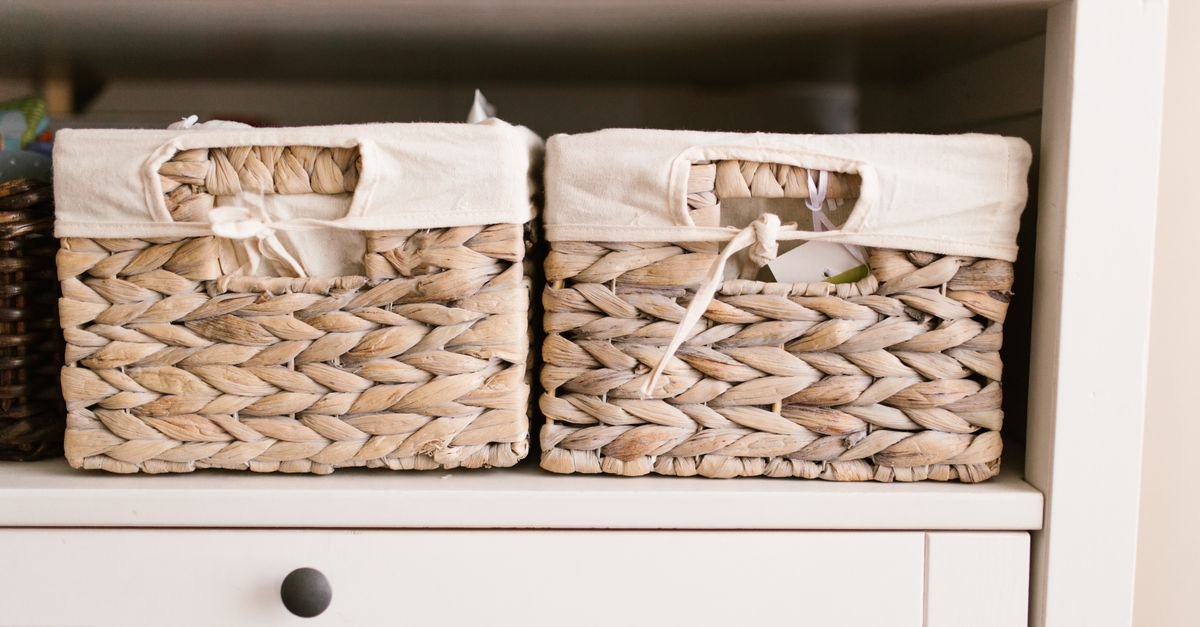
A proper dresser that doubles as the changing table (pad on top now, regular dresser at age three — skip the single-purpose changing table entirely), lidded fabric baskets in one matching family (visual calm plus stackability), drawer dividers, hanging closet organizers (shelves-in-a-bag for blankets, sheets, next-size backstock), and door-back organizers — the free square footage every closet hides.
Convert (The Budget Wins)
A bookcase becomes open bin storage; a bar cart becomes a rolling feeding-zone station; a hanging shoe organizer becomes sock-bib-cream command central; and the under-crib void — with low flat bins — stores the next season’s size lineup invisibly.
Skip
Specialty single-purpose gadgets (wipe warmers age out in weeks), giant toy chests (everything sinks; toddlers excavate — shallow bins beat deep pits, as our toy storage guide details), decorative storage too pretty to touch, and anything unanchorable. On that note, the non-negotiable: every dresser, shelf, and bookcase in this room anchors to a stud — the future toddler WILL climb, and our childproofing guide treats anchoring as chapter one for a reason.

The Small-Nursery Playbook (When the Nursery Is a Corner)
Every principle compresses: the zones shrink to a crib wall, a dresser-top changing station, and a chair that borrows the living room; vertical becomes the strategy (wall shelves above the dresser, hooks behind doors, the closet worked floor-to-rod-to-shelf); under-crib bins carry the backstock; and the one-in-one-out rule enforces itself weekly rather than monthly.
The shared-room and studio version adds a visual boundary — a curtain, an open bookcase, a rug that defines “the nursery” — which matters less for the baby than for the parents’ sense that the home still has rooms. The same zone logic scales to the whole-home baby setup, where the nursery is one station among several.
The Two-Hour Weekend Reset (For the Room That Got Away)
Every nursery drifts — growth spurts outpace systems. The recovery protocol: (1) strip everything out of drawers and closet onto the bed, twenty minutes; (2) three piles — current size, outgrown (to labeled bins), future (to closet dividers) — forty minutes; (3) file-fold current back in with dividers, twenty minutes; (4) re-zone what migrated (toys back to bins, feeding gear back to its corner), twenty minutes; (5) label everything that isn’t, and stage the backstock basket — final twenty.
Two hours, one podcast, and the room runs for another season. Put the next reset on the calendar for the next size change — the system is maintenance, not monument.
The Go-Stations (Organization That Leaves the Room)
The nursery’s system extends to three satellites worth setting up the same weekend. The diaper bag: packed to a checklist taped inside its flap (diapers by count, wipes, two outfits, sealed snack tier as age allows), restocked on return — not at departure, when you are already late. The car kit: a small bin in the trunk with a change of clothes, wipes, a blanket, and the spare pacifier that ends highway emergencies.
And the downstairs basket: the daytime changing caddy plus a burp cloth and a toy, living wherever the family actually spends daylight — because a perfectly organized nursery two floors from the living room organizes nothing after 9 a.m. Restock all three on laundry day and the whole household runs on the nursery’s rhythm.
Frequently Asked Questions
How do I organize a nursery on a budget?
Spend on a real dresser and fabric bins; convert everything else — shoe organizers for small items, bookcases for bin storage, under-crib bins for backstock. The zone system and size-sorting method are free and do most of the work.
What is the best way to organize baby clothes?
By size, shop-style: closet dividers for every size range, current size file-folded in the dresser with drawer dividers, and a monthly rotation moving outgrown pieces to labeled bins. Never let three sizes share a drawer.
What should be within reach of the changing table?
Everything, one-handed: diapers on edge, wipes, cream, a spare outfit, the hamper, and the pail — one hand never leaves the baby. Keep a backstock basket nearby and restock on laundry day.
Do I really need a changing table?
No — a standard dresser with a secured changing pad does the same job and remains furniture for the next decade. Anchor it to the wall and keep the one-hand rule layout on top.
How do I keep the nursery from getting cluttered?
Closed storage for bulk, labels on every basket, a monthly size rotation OUT of the room, and the one-in-one-out rule for toys and gear. Clutter in nurseries is almost always yesterday’s sizes overstaying.
When should I set up nursery storage systems?
Before the birth if you can — sorting gifted clothes into size dividers while you still sleep is a gift to the person you’re about to become. The two-hour reset exists for everyone who reads this after.
The Closet, Fully Worked (The Nursery’s Best Square Footage)
A standard closet holds triple its default capacity once worked in layers. The rod layer: size dividers ruling the hanging space, with a second tension rod below doubling capacity the day the wardrobe grows past onesies. The shelf layer: labeled lidded bins for backstock — next-size clothes, extra bedding, the diaper stockpile bought on sale — heaviest bins lowest.
The floor layer: the backstock basket that refills the changing station, the outgrown-sizes bin currently in service, and the laundry hamper if floor space allows. The door layer: an over-door organizer whose pockets swallow socks, hats, creams, thermometers, and the small-parts chaos that otherwise colonizes drawer corners.
Two closet habits that compound: face every bin label outward (the 2 a.m. rule applies in the closet too), and keep one deliberately EMPTY bin at all times — the landing zone for the next size-out wave, so rotation never waits on a shopping trip.
No closet at all? A freestanding wardrobe or a curtained corner shelf-unit runs the identical system — the layers matter, not the door.
What Experienced Parents Would Skip Next Time (The Honest Registry Note)
The nursery storage aisle sells beautifully to first-time nesters — and second-time parents shop differently. The consistently skipped: the wipe warmer (outgrown in weeks), the dedicated changing table (the dresser does it and stays), themed hamper sets (any lidded basket), tiny hangers beyond one pack (folding wins for baby clothes), and the heirloom-grade toy chest (see every organizer’s objection to deep chests).
The consistently kept: MORE plain bins than seemed reasonable, the label maker (or tape and a marker — the labels matter, not the gadget), the over-door organizers, the under-crib bins, and a second changing caddy the day it becomes obvious one floor of supplies cannot serve a two-floor life.
The registry translation: ask for storage infrastructure over single-purpose gadgets, sizes AHEAD over newborn-size mountains (the 0–3 drawer overflows while 9–12 sits empty), and gift cards for the reorganization month that always comes. The system in this guide costs less than three catalog gadgets — and outlives them all by years.
The Handoff Test (The System’s Real Exam)
A nursery is organized when someone who has never seen it can run it: the grandparent arriving for the weekend, the sitter at bath time, the bleary partner on the night shift. Labels facing out, zones doing one job each, and the changing station passing the one-hand rule — if a stranger can find a sleeper and survive a diaper change without texting you, the room has graduated. That test, not the basket aesthetics, is what this whole system was for.
And the encouragement every tired parent deserves: the nursery does not have to be finished, photogenic, or Pinterest-ready — it has to hand you a diaper one-handed at 2 a.m. and surrender a clean sleeper without a search party. Build for those two moments and the room is already succeeding, whatever the baskets match.
The Bottom Line
Nursery organization is three habits wearing a room’s worth of baskets: zones so everything has one home, size-sorting so growth never buries you, and the monthly rotation that keeps the room in the present tense.
Build it once, reset it seasonally, label it for the 2 a.m. shift — and the smallest room in the house will out-function every other one, exactly when you need it to.

I'm Nasir Uddin Khan, founder of HomeNeeds24 and a senior IT consultant with 18+ years' experience in Oracle database administration, enterprise infrastructure and ERP system design. I write the buying guides here and I build every calculator on the site myself, from published engineering standards rather than opinion. My research is structured rather than lab-based: manufacturer specifications, safety and efficiency standards, and the trade-offs that repeat across large volumes of verified customer reviews. Where I have direct hands-on experience — smart home, networking, energy and anything computer-adjacent — I say so in the guide.