
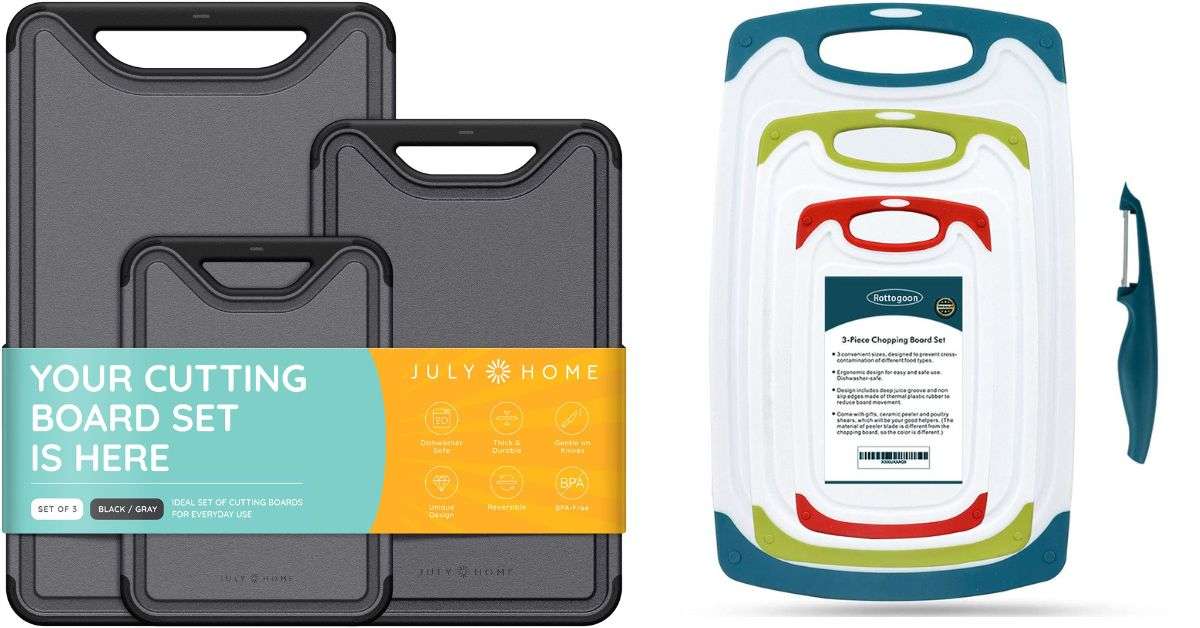
A cutting board needs enough working room while still fitting the sink and storage area. Compare materials by their care requirements rather than assuming one material is universally better. A board that cannot be cleaned as directed is a poor match for the routine.
Also Read


Review scope: This is a selection guide, not a hands-on product test. The linked products are unranked references, not verified performance recommendations. Check current model details, availability and terms with the seller and manufacturer.
Start with these checks
- Measure the usable cutting area.
- Check sink and cupboard fit.
- Read washing and drying instructions.
- Plan separation of food-preparation tasks.
Put the comparison into practice
Mark the board size on the counter and allow space for ingredients and a receiving bowl. Then compare that outline with the sink and storage opening. A very large board can improve working room while making washing, drying and storing it harder in a compact kitchen.
Further buying considerations
Material
The material of the cutting board is one of the most important factors to consider. The most common materials are wood, plastic, and bamboo. Each material has its own advantages and disadvantages.
- Wood: Durable and gentle on knives, but requires regular maintenance to prevent bacteria growth.
- Plastic: Easy to clean and sanitize, but can dull knives over time.
- Bamboo: Sustainable and eco-friendly, but can be prone to cracking.
Size
The size of the cutting board should be chosen based on your needs. If you have limited counter space, a smaller board may be more practical. However, if you frequently prepare large meals, a larger board may be necessary.
Thickness
The thickness of the cutting board can affect its durability and stability. Thicker boards are generally more durable, but may be heavier and harder to handle. Thinner boards are lighter and easier to handle, but may not last as long.
Surface Texture
The surface texture of the cutting board can affect how easy it is to use. A smooth surface may be easier to clean, but can be slippery when cutting. A textured surface can help prevent slipping, but may be harder to clean.
Maintenance
Consider how easy the cutting board is to clean and maintain. Some boards require regular oiling or conditioning to prevent cracking and bacteria growth. Others can be easily cleaned with soap and water.
By considering these factors, you can choose a cutting board that meets your needs and helps you prepare meals with ease.
Before deciding
Record the exact item, the requirements it must meet and the source of each answer. Leave missing details marked unknown and ask the seller to clarify them. Check the complete delivered cost and the return conditions for that specific item; neither a similar model nor a listing photo resolves unanswered questions.
Unranked product references
These links identify options mentioned in the original article. They are not a tested shortlist, and a listing title is not an independently checked specification. Use them only after applying the criteria above.
- Farberware Large Cutting Board
- JULY HOME Cutting Board Set
- Hiware Extra Large Bamboo Cutting Board
- Viretang Plastic Cutting Board
- ROTTOGOON Cutting Boards
Affiliate disclosure: As an Amazon Associate, HomeNeeds24 earns from qualifying purchases. See the affiliate disclosure for details.

I'm Nasir Uddin Khan, founder of HomeNeeds24 and a senior IT consultant with 18+ years' experience in Oracle database administration, enterprise infrastructure and ERP system design. I write the buying guides here and I build every calculator on the site myself, from published engineering standards rather than opinion. My research is structured rather than lab-based: manufacturer specifications, safety and efficiency standards, and the trade-offs that repeat across large volumes of verified customer reviews. Where I have direct hands-on experience — smart home, networking, energy and anything computer-adjacent — I say so in the guide.