
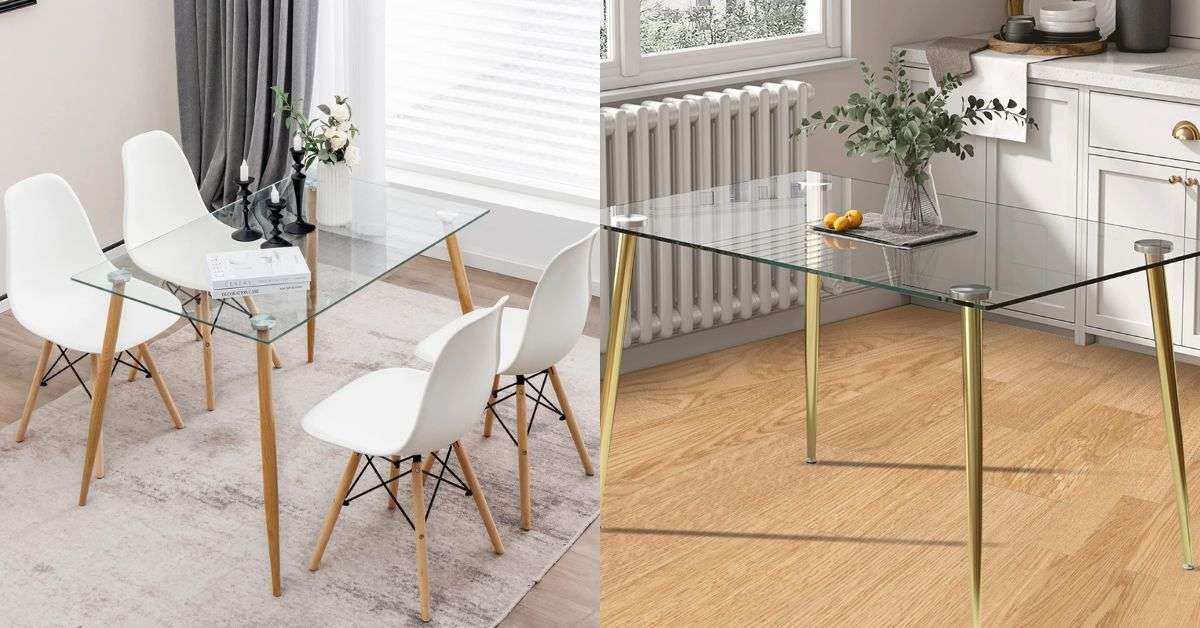
A dining table needs space both for diners and for movement around it. Mark its outline on the floor and include chairs in the occupied area. Extending designs need a second measurement in their open position and a place to store removable leaves.
Also Read



Review scope: This is a selection guide, not a hands-on product test. The linked products are unranked references, not verified performance recommendations. Check current model details, availability and terms with the seller and manufacturer.
Start with these checks
- Measure the table in closed and extended positions.
- Allow room to pull chairs out.
- Check leg positions against intended seating.
- Plan delivery through doors and stairs.
Put the comparison into practice
Tape the table footprint on the floor, then place the intended chairs around it. Repeat the exercise with an extending table fully opened. Look for collisions with door swings, cabinets and the main walking route; the room dimensions alone do not describe the usable dining area.
Before deciding
Record the exact item, the requirements it must meet and the source of each answer. Leave missing details marked unknown and ask the seller to clarify them. Check the complete delivered cost and the return conditions for that specific item; neither a similar model nor a listing photo resolves unanswered questions.
Unranked product references
These links identify options mentioned in the original article. They are not a tested shortlist, and a listing title is not an independently checked specification. Use them only after applying the criteria above.
- Baysitone Glass Dining Table
- Amyove Folding Dining Table
- Tangkula 5 Pieces Dining Room Table Set
- VANSPACE Folding Dining Table
- STHOUYN 6 Piece Dining Table Set
- Livinia Aslan 47" Wooden Dining Table
- OGMILL Small Dining Table
Affiliate disclosure: As an Amazon Associate, HomeNeeds24 earns from qualifying purchases. See the affiliate disclosure for details.

I'm Nasir Uddin Khan, founder of HomeNeeds24 and a senior IT consultant with 18+ years' experience in Oracle database administration, enterprise infrastructure and ERP system design. I write the buying guides here and I build every calculator on the site myself, from published engineering standards rather than opinion. My research is structured rather than lab-based: manufacturer specifications, safety and efficiency standards, and the trade-offs that repeat across large volumes of verified customer reviews. Where I have direct hands-on experience — smart home, networking, energy and anything computer-adjacent — I say so in the guide.