
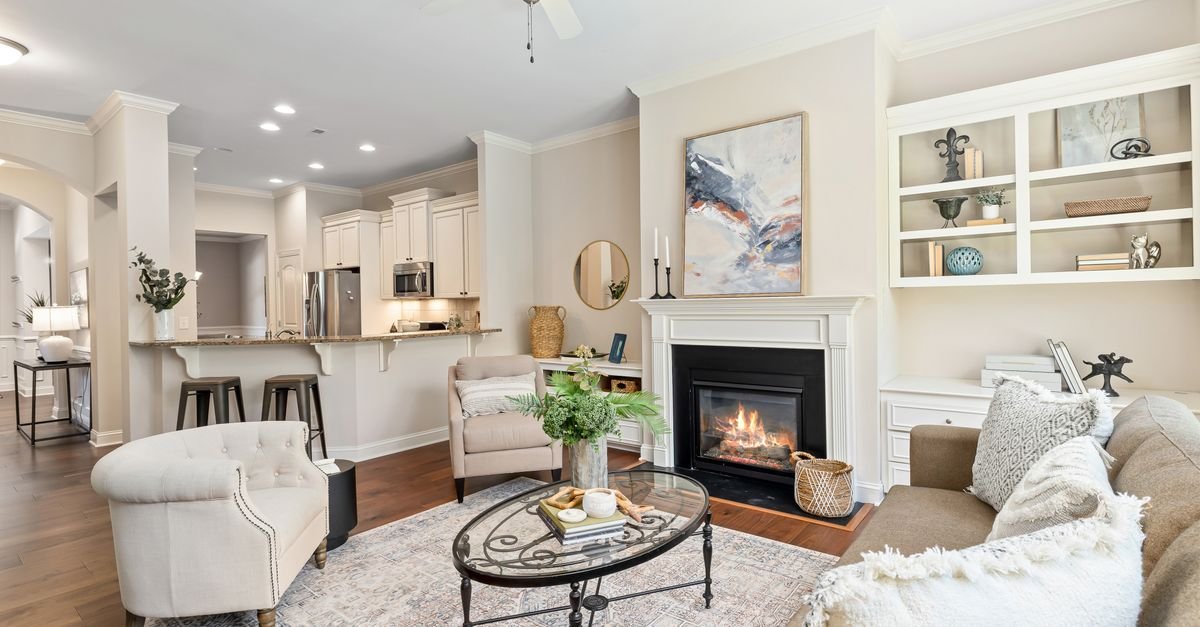
There are two kinds of shelves in the world: the ones in design magazines that look effortlessly collected, and the ones at home holding seventeen paperbacks, a phone charger, and a mug you forgot in 2024.
Also Read

The difference isn’t taste, budget, or a stylist on retainer. It’s a handful of learnable rules — the same ones behind styled coffee tables and gallery walls, adapted for horizontal real estate.
Quick answer: To style shelves like a designer: empty everything first, then rebuild using the trio formula — on each shelf, group books (some vertical, some stacked horizontally), one organic element (plant or branch), and one object with height or character. Vary the arrangement shelf to shelf so the eye zigzags, keep about 30% of every shelf empty, repeat a limited palette throughout, and anchor the lowest shelf with the biggest, heaviest-looking items.
Key Takeaways
- Empty first, style second — editing is 60% of shelf styling; you can’t arrange your way around clutter.
- Use the books + organic + object trio on each shelf, varied in placement so arrangements zigzag down the unit.
- Keep roughly 30% of every shelf empty — air is what makes the rest look curated.
- Books are decor: mix vertical rows with horizontal stacks that double as pedestals.
- Limit the palette to 2–3 colors plus wood/metal accents repeated top to bottom.
- Big and heavy lives low, light and airy lives high — visual weight sinks, always.
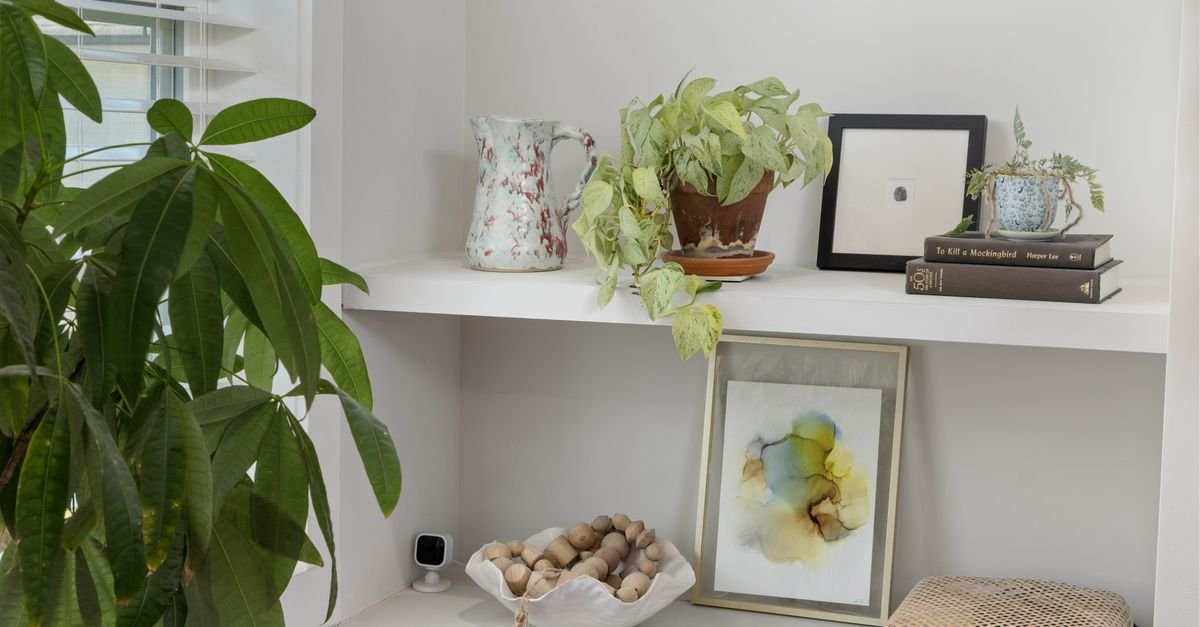
Why Do Designer Shelves Look So Different From Mine?
Because designers style shelves as one composition viewed from across the room — while the rest of us fill them one object at a time, up close, over years.
Stand back and squint at magazine shelves and you’ll spot the pattern: repeated colors, alternating shapes, deliberate gaps, and a zigzag rhythm that pulls the eye diagonally down the unit.
Nothing on those shelves is individually spectacular. The arrangement is doing all the work — which is excellent news, because arrangement is free.
What’s Step One? (Hint: It’s a Demolition)
Take everything off. Yes, everything — the whole unit, bare.
This is non-negotiable for two reasons. First, shelves accumulate by sediment: each object made sense once, but the collection never got composed. You can’t fix sediment by nudging it.
Second, the empty unit shows you what you’re working with: the shelf heights, the natural focal zones, the backdrop color your objects will live against.
While it’s all down, sort into three piles: display-worthy (beautiful, meaningful, or usefully sculptural), storage (needed but not lovely — destined for baskets and boxes), and gone (the 2024 mug knows what it did).
Most home shelves are trying to display three times too much. The pile system fixes the math before styling begins.
What Is the Trio Formula for Each Shelf?
Designers rarely say it this plainly, but watch their hands (HGTV’s Carmeon Hamilton demonstrates it beautifully in the video above): almost every styled shelf holds a variation of the same three ingredients.
1. Books — the workhorse
Some standing vertically (held by a bookend or simply the shelf wall), some stacked flat — and those flat stacks become pedestals for small objects. Books give shelves mass, warmth, and intellectual charm all at once.
2. Something organic — the life
A trailing pothos, a small potted plant, a branch in a bud vase, even good faux eucalyptus. One living (or living-looking) thing per shelf zone keeps the composition from feeling like a showroom.
Trailing plants earn extra credit on high shelves — the cascade softens hard shelf lines like nothing else.
3. An object — the character
One vase, bowl, candlestick, small sculpture, framed photo, or souvenir with an actual story. This is the personality slot — and one confident object beats four timid ones.
Then vary the trio’s arrangement shelf by shelf — books left on one shelf, books right on the next — so nothing stacks identically above anything else. That’s the zigzag that reads as “effortless.”
How Do You Style Books Like a Designer?
Books deserve their own masterclass — they’re most people’s biggest shelf asset and most common shelf mistake.
Break up the long row. A full shelf of vertical spines reads as storage. Split it: a vertical run, then a horizontal stack, then air.
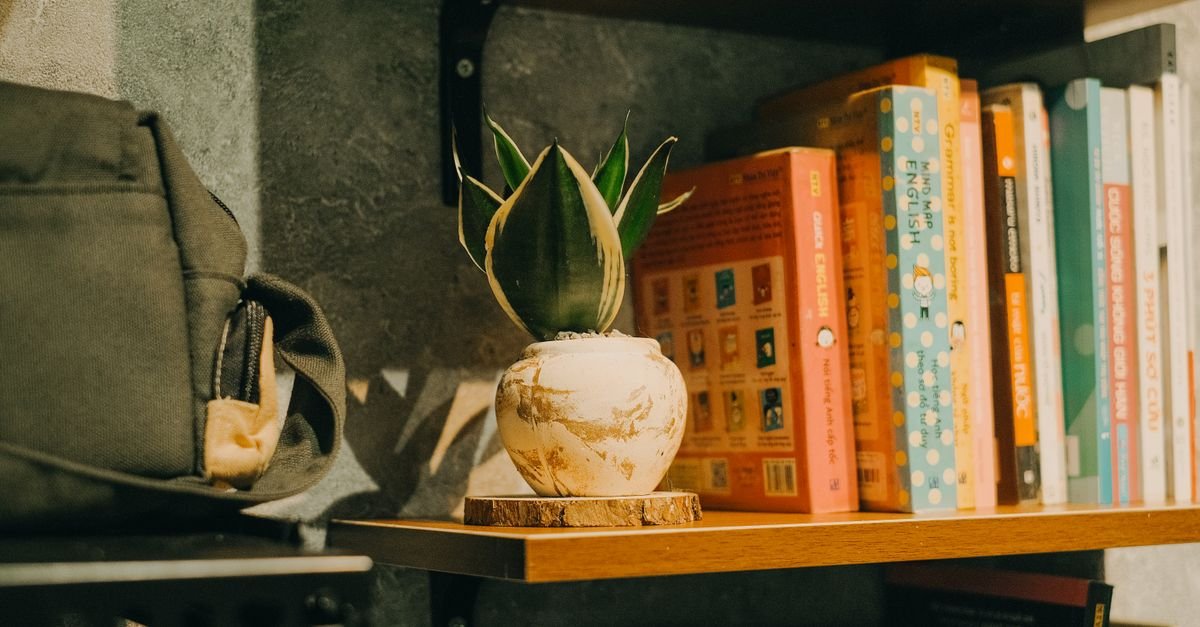
Stack horizontally in threes and fives — odd numbers, largest at the bottom — and crown the stack with a small object: a bowl, a candle, a tiny plant. Instant vignette.
Pull spines to the shelf edge. Books flush with the front edge (not pushed to the wall) create a clean line and hide shelf-back shadows.
Curate the covers you see. The books facing outward set the palette — mix in neutral spines wherever the rainbow gets loud. (Turning all pages outward for beige uniformity is a step too far — your books deserve their identities.)
Retire what you’d never reread to a closed cabinet or donation box. Display shelf space is prime real estate — rent it to favorites.
How Much Empty Space Should Shelves Have?
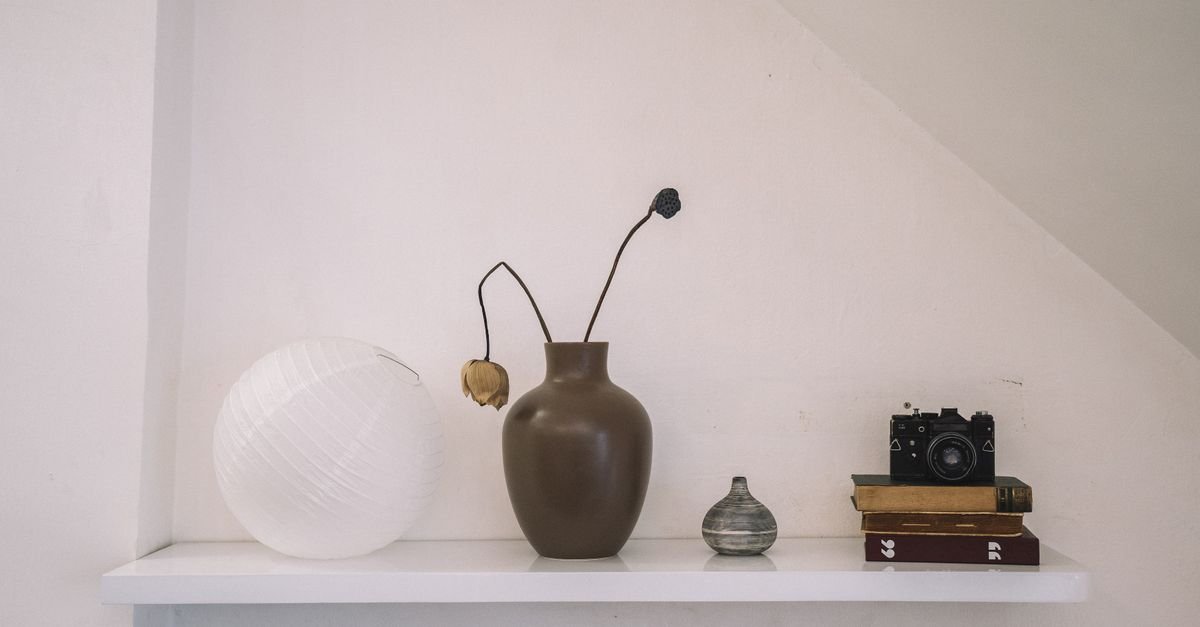
Aim for roughly 30% air per shelf — and expect it to feel wrong for the first day.
Empty space is what separates “curated” from “crowded.” It gives each vignette a frame, lets shapes read as shapes, and signals confidence — a packed shelf whispers storage problem; a breathing shelf says everything here was chosen.
The same principle runs through all of decorating’s greatest hits — it’s the negative-space rule from our coffee table guide standing upright, and the secret behind rooms that feel bigger than they are (full playbook in making a small room look bigger).
Practical trick: style each shelf, then remove one thing. When the removal hurts slightly, the shelf is done.
How Do You Keep a Whole Unit Cohesive?
Individual shelves can be perfect while the whole bookcase still looks chaotic — cohesion is a unit-level game:
Limit the palette. Two to three repeating colors plus consistent wood and metal tones, distributed top to bottom. Repetition is what makes a collection read as intentional.
Zigzag the visual weight. Sketch the diagonal: if the plant sits left on shelf one, it lands right on shelf two. Alternate book blocks, objects, and gaps the same way.
Sink the heavy things. Largest baskets, biggest books, chunkiest ceramics on the lowest shelves; lighter, smaller, airier pieces ascending. Bottom-heavy is stable; top-heavy is anxious.
Repeat one material at least three times — three brass moments, three woven textures — scattered across different shelves. Triangulated repetition stitches the whole unit together.
Let baskets do the dirty work. Matching bins on the bottom shelf swallow the remotes, chargers, and life-debris — visible order, hidden chaos.
How Do You Style Different Kinds of Shelves?
Floating shelves
The minimalist’s stage: fewer, better objects with generous spacing. One trio per shelf, maximum — floating shelves collapse visually under crowding faster than any bookcase. Overlap a leaning frame behind a plant for easy depth.
Built-ins and big bookcases
Symmetry is your friend at the unit level: balance (not mirror) the two halves, keep the eye-level shelves for the best vignettes, and push storage baskets to the lowest row. The middle-third of a built-in is its gallery wall — style it hardest.
Open kitchen shelving
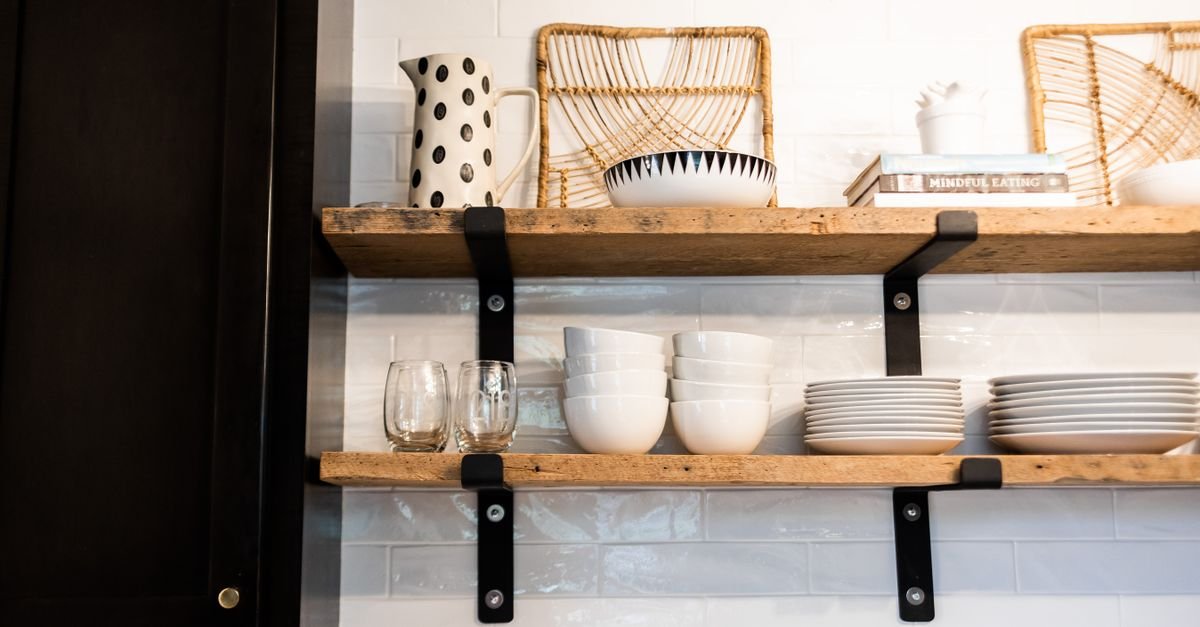
Function styled beautifully: everyday plates and bowls stacked as deliberate towers, glasses in rows, one plant or cookbook vignette per shelf. The trick is uniformity — matching dishware reads as decor; mixed freebie mugs read as cupboard overflow.
Bathroom and hallway ledges
One to two objects and something green — small ledges want haiku, not novels.
What Are the Most Common Shelf-Styling Mistakes?
The airport-souvenir museum. Everything you own on display at once. Rotate collections seasonally instead — storage is the stylist’s secret archive.
All small things. Twenty tiny objects read as noise from sofa distance. Scale up: fewer pieces, bigger presence.
Symmetrical sameness. Identical arrangement on every shelf turns a bookcase into a filing cabinet. Zigzag or perish.
Ignoring the backdrop. A busy wallpapered alcove wants calmer styling; a plain white unit can carry bolder objects. The shelf back is part of the composition.
Pushing everything to the back wall. Objects belong in the front two-thirds of shelf depth — layered, with small things in front of leaning larger things.
Forgetting lamplight. A tiny lamp or battery picture light on a mid-height shelf turns the whole unit into evening ambience — the most-skipped upgrade in shelf styling.
Can You Style Shelves on a Zero Budget?
Shelf styling is the most shoppable-at-home project in decor:
Your bookshelf already owns the books. Restack, split, pedestal — free transformation number one.
Raid other rooms: the kitchen’s wooden bowl, a single beautiful glass, the bedroom’s framed photo — shelves love defectors.
Propagate the plants you have — a pothos cutting in a jam jar is a designer object in eight weeks.
Nature’s props department: branches, stones, pinecones in a bowl — seasonal, sculptural, free.
Thrift the rest: vases, bookends, brass whatnots — the classic sources, a few dollars each. Spray paint unifies any mismatched haul.
Shelf-styling staples — solid Amazon searches:
How Do You Create Depth on a Shelf? (The Three-Layer Trick)
Flat-styled shelves — everything in one front-facing row — are the last gap between “nice” and “designer.” The fix is layering in three depths:
Back layer: something tall leaning against the shelf back — a framed print, a cutting board in kitchens, a large flat dish on its stand. This is the backdrop.
Middle layer: the main event — the book stack, the vase, the plant.
Front layer: one small, low object slightly overlapping the middle — a tiny bowl, a stone, a small candle — placed off-center.
The overlap is the magic: when objects partially hide each other, the vignette reads as collected and three-dimensional instead of lined up for inspection.
Try it on one shelf tonight — lean a frame, park the stack in front, drop a small object at the edge. The before/after usually converts people instantly.
What About Shelves in Homes With Kids and Renters’ Walls?
Kid-proof zoning: bottom shelves get the indestructibles — baskets, board books, wooden bowls — and everything precious migrates above the reach line. Style for the household you have.
Renter reality: freestanding bookcases deliver the full styling canvas with zero wall damage, and adhesive-mounted floating shelves handle the light stuff. Anchor tall units to the wall regardless — safety strips are cheap and invisible.
Frequently Asked Questions
How do you style shelves like a designer?
Empty the unit completely, edit ruthlessly, then rebuild with the trio formula per shelf — books (mixed vertical and stacked), one organic element, one character object — varying placement shelf to shelf so arrangements zigzag. Keep about 30% of each shelf empty and repeat a limited palette throughout.
What should you put on shelves besides books?
Plants or branches, vases and bowls, framed photos or small art, candlesticks, sculptural objects, and woven baskets for hidden storage. The reliable mix per shelf: something living, something with height, something personal — anchored by books.
How full should shelves be?
About 70% styled, 30% air. Empty space frames each vignette and makes the collection read as curated rather than crowded — if every shelf is full, the whole unit reads as storage no matter how nice the objects are.
How do you arrange books on shelves so they look good?
Break long vertical rows with horizontal stacks of three or five (largest on the bottom), top stacks with a small object, pull all spines to the shelf’s front edge, and mix in neutral spines where colors get loud. Display favorites; store or donate the rest.
How do you make a bookshelf look cohesive?
Repeat two to three colors and one or two materials (wood, brass, ceramic) at least three times each across different shelves, alternate the visual weight in a zigzag down the unit, and put the biggest, heaviest items on the lowest shelves.
How do you style floating shelves?
Sparser than bookcases: one small vignette per shelf — a short book stack, a plant, one object — with generous air around it. Layer a leaning frame behind for depth, and let trailing greenery soften the shelf’s hard line.
What do you put on the bottom shelf of a bookcase?
The visual heavyweights: matching storage baskets (which also swallow real-life clutter), oversized books, and the chunkiest ceramics. Bottom-heavy styling makes the whole unit feel grounded and lets the eye-level shelves carry the delicate, decorative moments.
The bottom line
Designer shelves are a formula wearing a good outfit: edit down, trio up, zigzag the weight, and leave a third of every shelf breathing. Empty yours this weekend and rebuild in an hour — the 2024 mug goes to the kitchen, and the shelf finally goes in the family photos.

I'm Nasir Uddin Khan, founder of HomeNeeds24 and a senior IT consultant with 18+ years' experience in Oracle database administration, enterprise infrastructure and ERP system design. I write the buying guides here and I build every calculator on the site myself, from published engineering standards rather than opinion. My research is structured rather than lab-based: manufacturer specifications, safety and efficiency standards, and the trade-offs that repeat across large volumes of verified customer reviews. Where I have direct hands-on experience — smart home, networking, energy and anything computer-adjacent — I say so in the guide.